The books, videos, websites, and organizations listed here
offer support, guidance, and inspiration to abused women. There
is also wonderful information in these resources for friends and
family wishing to assist a woman who is being mistreated in a
relationship, and for community activists seeking to confront
the wider social problem of abuse and violence. Although most
of these resources refer to "domestic violence" or "battering,"
they are almost all equally relevant to women who have experienced
verbal, economic, or sexual coercion.
For Women of All Backgrounds
• National Domestic Violence Hotline for
the United States and Canada: 1-800-799-SAFE.
Call this number to receive a referral to the closest hotline
for abused women in your area. The use of this number is not
restricted to women who have experienced physical violence:
Women and teens are welcome to call with any issue regarding verbal
abuse or control in a relationship, or just because something
is happening in their relationship that is making them uncomfortable.
• Rape, Abuse, and Incest National Network
Hotline (Rain): 1-800-656-4673.
Call this number if you have been sexually assaulted or
sexually abused by your partner or ex-partner (or by anyone else),
and you will be connected immediately to the sexual assault hotline
closest to you.
Why Does He Do
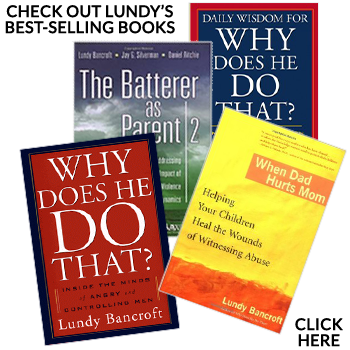
That?: Inside the Minds of Angry and Controlling Men , by Lundy Bancroft (G.P. Putnam)
The book that answers the 20 questions that women most
commonly ask about controlling or abusive relationship partners,
including why he treats other people so much better than he treats
you, how he came to be the way he is, why his good periods don’t
last, and how to tell if he is really going to change or not.
• When Love Goes Wrong: What To Do When
You Can't Do Anything Right,
by Ann Jones and Susan Schechter (Harper Perennial).
This is the essential book for women who are seeking guidance
on how to cope with a controlling partner and how to move towards
freedom and recovery. It is practical, down to earth, and accurate,
and covers in detail a wide range of issues that women face.
• It's My Life Now: Starting Over After an Abusive
Relationship or Domestic Violence, by Meg Kennedy Dugan and Roger Hock (Routledge).
Despite the title, this book is equally valuable for women
who are still involved with an angry or controlling partner and
for those who have left. This is a wonderful, warm, compassionate
book by authors that deeply understand both emotional and physical
abuse.
• The Verbally Abusive Relationship:
How To Recognize It and How To Respond,
by Patricia Evans (Bob Adams).
Evans' book takes the reader through the details of verbally
abusive tactics in relationships, and how to understand their
effects on you. She offers terrific insight and practical advice.
(The book contains a couple of the common misconceptions about
the psychology of abusers, but this is a very minor drawback compared
to its many strengths.)
• Into the Light: A Guide for Battered
Women,
by Leslie Cantrelli (Chas. Franklin Press)
This booklet is short and simple, with accurate information
and good advice. This is a great resource for a woman who does
not have the time or energy for the longer books listed above,
or who wants to have quick inspiration handy.
• Not to People Like Us: Hidden Abuse
in Upscale Marriages,
by Susan Weitzman (Basic Books).
A valuable expose of abuse among the wealthy, with important
guidance for abused women. Weitzman's descriptions of abusive
men are accurate and helpful (though a couple of the myths slip
in). I recommend this book highly.
For Teenagers and Their Parents
• What Parents Need to Know About Dating
Violence,
by Barrie Levy and Patricia Occhiuzzo Giggam (Seal Press).
The essential book for parents who are concerned that their
daughters or sons may be involved in abusive dating relationships.
Compassionate, insightful, and highly practical, written by people
who grasp the wide range of anxieties and challenges that parents
face.
• In Love and Danger -- A Teen's Guide
to Breaking Free of Abusive Relationships, by Barrie Levy (Seal Press).
A guide for the teenager herself in responding to an abusive
or controlling partner, written in just the right tone and language
to reach adolescents - an excellent book. It's out of print, so
look for it used or at the library, or try to find it online.
For Women of Color
• Chain Chain Change: For Black Women
in Abusive Relationships,
by Evelyn C. White (Seal Press).
This excellent book remains the key reading resource for
any African-American woman who is involved with a controlling
or abusive partner. It provides general information combined with
guidance that is specific to the black woman's experience, and
includes a section speaking to abused black lesbians.
• Mejor Sola Que Mal Acompañada:
For the Latina in an Abusive Relationship, by Myrna Zambrano (Seal Press).
Zambrano's book for Latina women in abusive relationships
is available in a bilingual edition, making it readable for women
who use Spanish or English as their primary language. This excellent
resource speaks to the cultural context in which Latinas live,
and offers specific validation and recommendations.
• Black Eyes All of the Time: Intimate
Violence, Aboriginal Women, and the Justice System, by Anne McGillivray and Brenda Comaskey
(University of Toronto).
The experience of abused indigenous (native) women is told
largely in their own voices in this wonderful and groundbreaking
volume. Although there are a few portions where the writers use
some difficult academic language, the great majority of the book
is highly accessible and moving.
• Mending the Sacred Hoop
202 E. Superior St.
Duluth MN 55802
(218) 722-2781
www.duluth-model.org , then select "Mending the Sacred
Hoop"
This project of Minnesota Program Development focuses on
addressing the abuse of women in tribal cultures.
• Institute on Domestic Violence in the African-American
Community
Univ. of Minnesota School of Social Work
290 Peters Hall
1404 Gortner Ave.
St. Paul MN 55108-6142
(877) 643-8222
www.dvinstitute.org
This organization's website includes resources for abused
women themselves, while also reaching out to policy makers, researchers,
and other concerned community members.
• National Latino Alliance for the Elimination
of Domestic Violence
P.O. Box 22086
Ft. Washington Station
New York NY 10032
(646) 672-1404
www.dvalianza.org
Mostly oriented toward research and policy. Extensive listings.
• Asian and Pacific Islander Institute on
Domestic Violence
942 Market St., Suite 200
San Francisco CA 94102
(415) 954-9964
www.apiahf.org , then select "Programs",
then select the Institute
For Lesbians
Naming The Violence: Speaking Out About Lesbian Battering, edited by Kerry Lobel (Seal Press).
While this 1986 book is regrettably out of print, you can
find it through a library or used book store, or online. The personal
stories of many abused lesbians are shared here, to help you to
identify the problem and know that you are not alone.
Woman To Woman Sexual Violence: Does She Call It Rape?, by Lori Girshick (Northeastern University
Press).
With the stories of survivors of sexual assaults by same-sex
partners woven through, this book reports on an important survey
and helps bring to light a seldom-examined aspect of intimate
partner abuse.
Lesbians Talk: Violent Relationships, by Joelle Taylor and Tracy Chandler (Scarlet Press).
This is a short book that draws from the voices of women
themselves to describe the problem of abuse in lesbian relationships
and offer solutions.
Same-Sex Domestic Violence: Strategies for Change, by Beth Leventhal and Sandra Lundy
(Sage Publications).
This well-written and insightful book offers guidance to
community members who want to address the needs of abused lesbians
and gay men, explaining the structuring of service provision and
the overcoming of institutional barriers.
(On the web, try going to Gayscape and doing a search for
"domestic violence" -- many listings are available for
organizations, publications, and websites.)
For Immigrant and Refugee Women
• Family Violence Prevention Fund
383 Rhode Island St., Suite 304
San Francisco CA 94103-5133
(415) 252-8900
www.endabuse.org , then select "Immigrant Women,"
then select "Help is Available"
FVPF helps abused immigrant women to get information about
their rights and options and to find referrals to programs in
their area.
• NOW Legal Defense and Education Fund
Immigrant Women's Project
1522 K St., NW, Suite 550
Washington DC 20005
(202) 26-0040
www.nowldef.org , then select "Issues," then
select "Immigrant Women"
• National Lawyers Guild
National Immigration Project
14 Beacon St., Suite 602
Boston MA 02108
(617) 227-9727
www.nlg.org , then select "National Immigration
Project", then select "Domestic Violence"
About Children of Abused Women
• Childhood Experiences of Domestic Violence, by Caroline
McGee (Jessica Kingsley).
Although this is a professional book, it is very readable
and compassionate. McGee understands the challenges an abused
mother faces. Told largely in the words of mothers and children
themselves, this is the single best introduction I have found
to the experiences of children exposed to an abusive man, with
extensive guidance for how to effectively assist them to safety
and recovery.
• The Batterer
As Parent: Addressing The Impact of Domestic Violence On Family
Dynamics, by Lundy Bancroft and Jay Silverman
(Sage Publications).
Although this professional book focuses on physically abusive
men, the great majority of what we cover applies to verbally abusive
and controlling men as well. We explain how an abusive man can
affect the relationships between a mother and her children and
between siblings, and how abusers may try to continue their control
through the children post-separation. Abused mothers, including
those involved in the family court system, report finding this
book both validating and helpful.
• Children Who See Too Much: Lessons
From The Child Witness To Violence Project, by Betsy McAlister Groves (Beacon
Press).
This book is for parents or professionals who are assisting
children who have been exposed to serious physical violence, including
domestic violence, to help them understand children's emotional
reactions and their recovery needs. It is brief but very clear
and helpful.
About Child Custody, Divorce, and Child Support
(In addition to the resources listed in this section, see
the book The Batterer as Parent listed
above, which deals extensively with child custody issues.)
• Resource Center on Domestic Violence:
Child Protection and Custody, operated by the National Council
of Juvenile and Family Court Judges: (800) 527-3223.
The Resource Center offers a free packet of information
for abused women in custody and visitation litigation. It does
not become involved in specific cases or provide legal advice.
They also offer a book called Managing Your Divorce that helps women prepare for the process
of resolving child custody, visitation, and child support.
• Battered Women's Justice Project: (800) 903-0111,
x2
The BWJP provides support, consultation, and referrals
to abused women facing custody or visitation challenges from their
abusive ex-partners, including assistance in finding a well-trained
and sensitive attorney.
• Women and Children Last: Custody Disputes
and the Family "Justice" System, by Georgina Taylor, Jan Barnsley,
and Penny Goldsmith of the Vancouver (BC) Custody and Access Support
and Advocacy Association.
This excellent book prepares abused mothers for the difficult
emotional and legal challenges of family court litigation, to
help increase their ability to keep their children safe and maintain
custody. Advocates and concerned community members can also benefit
from the explanations offered here of how the family court system
works and why abused women can find the environment so hostile.
(For ordering information call Vancouver Status of Women at 604-255-6554.)
• The Battered Mothers Testimony Project:
A Human Rights Report on Child Custody and Domestic Violence.
This activist project interviewed 40 abused women about
their experiences of being revictimized by family courts through
the abuser's use of custody and visitation litigation, and also
interviewed numerous judges, custody evaluators, and advocates.
The project report, which exposes these systemic abuses as violations
of women's internationally-recognized human rights, is available
from: Publication Office, Wellesley Centers for Women, Wellesley
College, (781) 283-2510, or at www.wcwonline.org
• "Small Justice: Little Justice in
America's Family Courts," a video by Garland Waller of Boston
University
This one-hour video documents three cases where abused
women have faced systematic mistreatment by family courts as they
attempt to protect their children from domestic violence and sexual
abuse. This well-made and carefully researched film is an important
resource for community members working for court reforms. (Available
from Intermedia, 800-553-8336)
• Divorced From Justice: The Abuse of
Women and Children by Divorce Lawyers and Judges, by Karen Winner (Regan Books).
This is another book that is out of print, but you can
find it at libraries, used book stores, or online. The stories
are painful ones which makes the book heavy reading, but Winner
offers crucial advice to women and to anyone who is trying to
help them, in addition to giving important suggestions to people
interested in working for court reform.
• The Hostage Child: Sex Abuse Allegations
in Custody Disputes, by Leora Rosen and Michelle Etlin (Indiana University Press).
An eye-opening education for people interested in working
towards family court reform, this book documents the obstacles
that abused women can encounter in attempting to protect their
children from abuse even in cases where extensive evidence exists.
(I don't recommend this book for abused women to read themselves
if they are currently involved in litigation - it's very frightening,
and most cases don't go as badly as the ones presented here.)
• National Child Support Enforcement Association
444 North Capitol St., Suite 414
Washington DC 20001-1512
(202) 624-8180
www.ncsea.org
NCSEA provides information on child support collection,
with links to specific child support resources in your geographical
area.
For Mothers of Sexually Abused Children
A Mother's Nightmare -- Incest: A Practical Legal Guide
for Parents and Professionals, by John
E.B. Myers (Sage Publications).
Written by a smart and compassionate attorney, this is
a critical book for any woman who has reason to suspect that her
child has been sexually abused by the child's father or step-father,
whether or not the child has explicitly disclosed.
About General Parenting Issues
The books listed in this section are general parenting
guides, full of tremendous practical help and insight. I have
found all of these titles to be terrific. However, two words of
caution: 1) These books tend to not address the impact on children
of exposure to a man who abuses their mother, including the role
that abuse plays in as much as half of divorces, and 2) With the
exception of Real Boys, these books do not offer
detailed guidance to parents who have a gay or lesbian teen (though
Reviving Ophelia touches
on the issue briefly).
You can also find additional parenting resources in your
phone book, such as parental stress hotline numbers, Parent's
Anonymous, and various kinds of parent education classes, or do
an Internet search for "Parent Education."
• How To Talk So Kids Will Listen and
Listen So Kids Will Talk, by Adele Faber and Elaine Mazlish.
• Siblings Without Rivalry, by Adele Faber and Elaine Mazlish
(Avon).
• The Courage to Raise Good Men, by Olga Silverstein and Beth Rashbaum
(Penguin). Consider this book a must read for any parent of a son, especially
one who has been exposed to a man who mistreats his mother.
• Reviving Ophelia: Saving the Selves
of Adolescent Girls, by Mary Pipher (Grosset/Putnam).
• Real Boys: Rescuing Our Sons from the
Myths of Boyhood, by William Pollack (Random House).
• How to Mother a Successful Daughter, by Nicky Marone (Three Rivers).
• How to Father a Successful Daughter, by Nicky Marone (Fawcett Crest).
For Women Involved with Law Enforcement Officers
• Spouse Abuse by Law Enforcement (SABLE)
Life Span
P.O. Box 445
Des Plaines, IA 60016
(847) 824-0382
www.policedv.com
SABLE offers a booklet called Police Domestic Violence:
A Handbook for Victims for $5 (including shipping) from the
above address.
For Women in Faith Communities
• Minnesota Center Against Violence and
Abuse
www.mincava.umn.edu , then select "Faith Response"
This website offers many readings and resources regarding
the abuse of women for Christian, Jewish, and Islamic women, and
a collection of interfaith writings and organizations. A terrific
resource for women whose spiritual or religious involvement is
an important part of their lives.
• Keeping the Faith: Guidance for Christian
Women Facing Abuse, by Marie Fortune (Harper San Francisco).
Fortune offers clarity, advice, and validation, along with
new interpretations of scriptural texts, to assist abused Christian
women to escape entrapment and draw strength from their spiritual
beliefs. (I am not currently aware of similar books for women
of other faiths, but you may find one, as new resources on abuse
appear every day.)
About Abusive Men
The organizations listed here offer literature, videos,
and training for people interested in starting or improving counseling
programs for men who abuse women.
• Emerge: Counseling and Education to End
Domestic Violence
2380 Massachusetts Ave., Suite 101
Cambridge MA 02140
(617) 547-9879
www.emergedv.com
• Domestic Abuse Intervention Project
206 West Fourth St.
Duluth MN 55806
(218) 722-2781
www.duluth-model.org
For Those Assisting Abused Women
• To Be An Anchor In The Storm: A Guide
For Families and Friends of Abused Women, by Susan Brewster (Ballantine Books).
An outstandingly caring, practical, and wise book for the
loved ones of an abused woman. If you are trying to assist a woman
who is in a bad relationship, read this book. It will
help you to feel better and make you a much more effective helper. (However, one word
of caution: A section at the end of the book on reporting child
abuse contains information that I find ill-advised. Before you
involve child protective services with a mother you care about,
call a program for abused women in your area and seek advice about
whether and how to make a child abuse report.)
• Safety Planning With Battered Women, by Jill Davies, Eleanor Lyon, and
Diane Monti-Catania (Sage Publications).
This is a professional book, but is very readable and helpful
for anyone who wants to understand what is really involved when
a woman is considering leaving an abusive partner, and provides
guidance for how to help a woman be safer even if she can't
leave or doesn't want to. The authors talk about much more than
just safety planning -- they address the full range of practical
realities that abused women face in a way that I have found in
no other book.
• Trauma and Recovery, by Judith Herman (Basic Books).
Dr. Herman's book is the bible of trauma, especially for
those kinds of traumatic experiences for which the society tends
to blame the victim or deny the reality of her/his experience.
An outstandingly brilliant work.
About Overcoming Partner Abuse in Communities
• National Coalition Against Domestic Violence
1532 16th St., NW
Washington DC 20036
(202) 745-1211
www.ncadv.org
Join this organization to support policy and service development
to benefit abused women and their children. NCADV also has various
resources that you can order (at a discount if you are a member),
and listings of other sources of information.
• Next Time She'll Be Dead: Battering
and How to Stop It, by Ann Jones (Beacon Press).
This terrific work elucidates the cultural influences and
institutional actions that support abuse, and gives to-the-point
suggestions for concerned community members on how to end the
abuse of women.
• Rural Woman Battering and the Justice
System: An Ethnography, by Neil Websdale (Sage Publications).
This excellent book describes the special challenges faced
by abused women who live far from large population centers, who
may be very isolated and may face local communities are not supportive
of escaping abuse. Groundbreaking and insightful, with concrete
strategies for how agencies and institutions can better serve
abused women in rural areas.
• Coordinating Community Responses to
Domestic Violence: Lessons from the Duluth Model, edited by Melanie Shepard and Ellen
Pence (Sage Publications).
Detailed guidance on how to draw from the US's premier
model of collaborative work in communities to assist abused women,
hold abusers accountable, and change community values about partner
abuse.
• Pornography: The Production and Consumption
of Inequality, by Gail Dines, Robert Jensen, and Ann Russo (Routledge).
This highly readable book provides the most reasonable
and persuasive explanations that I have encountered of how pornography
can shape men's ways of perceiving and interacting with women,
and of the various excuses that groups and individuals use to
avoid looking at the damage that pornography can do.
• "Dream Worlds II," a video by
the Media Education Foundation.
This powerful and disturbing video reveals the attitudes
towards women that are taught by today's music videos. Available
from MEF, 26 Center St., Northampton MA 01060, (800) 897-0089,
www.mediaed.org .
• "Tough Guise," a video by the
Media Education Foundation.
This widely-acclaimed video created by Jackson Katz shows
how popular portrayals of masculinity force boys and men into
unhealthy roles, and teach males to be abusive towards females.
(See ordering information under previous listing.)
• Transforming Communities
734 A St.
San Rafael CA 94901-3923
(415) 457-2464
www.transformcommunities.org
Transforming Communities has a tremendous collection of
resources and ideas for how to combat the abuse of women and children.
For Male Allies
Many opportunities exist for men who want to be active
in stopping the abuse of women, and more appear every day. Below
are just a few examples.
• Men Overcoming Violence
1385 Mission St., Suite 300
San Francisco, CA 94103
(415) 626-MOVE
www.menovercomingviolence.org
Public speakers, counseling groups, and opportunities for
activism.
• Men Can Stop Rape
P.O. Box 57144
Washington DC 20037
(202) 265-6530
www.mencanstoprape.org
&n